Why YouTube Marketing Is the Biggest Opportunity of 2026
Here is an uncomfortable truth about digital marketing in 2026: if your business is not investing seriously in YouTube marketing, you are leaving your most valuable prospects in the hands of your competitors.
YouTube now has over 2.7 billion monthly active users. It is the second largest search engine on the planet, the second most visited website globally, and the only platform where a single piece of content can rank in both YouTube search and Google search simultaneously giving you two streams of organic traffic from one video.
Yet most businesses and creators still treat youtube marketing strategy as an afterthought. They post inconsistently, skip SEO entirely, and wonder why nothing grows. The result? Their competitors. Who understand youtube marketing strategy at a strategic level. Own the attention of every shared audience member.
This youtube marketing strategy fixes that. Whether you are building a brand from scratch, scaling an existing channel, or finally taking YouTube and marketing seriously as a business priority, this is the most complete breakdown of YouTube marketing strategies, tactics, real-world examples, and a step-by-step plan you will find in one place.
Let’s build your strategy from the ground up.
What Is YouTube Marketing Strategy and Why It Matters in 2026
Table of Contents
Marketing on YouTube means using the platform strategically to reach, educate, attract, and convert your target audience through video content. It is not simply uploading videos and hoping the algorithm finds you. Done correctly, marketing with YouTube creates a compounding content asset. Videos that rank in search, build trust over time, and drive traffic and revenue long after they are published.
Why YouTube in Marketing Outperforms Every Other Channel
Here is what makes YouTube for marketing fundamentally different from every other social platform:
- Intent-driven audience. Viewers come to YouTube searching for something specific. They chose your video from a results page and committed their time. That intent-driven engagement makes video marketing with YouTube one of the highest-converting traffic sources available.
- Dual search visibility. YouTube videos appear directly inside Google search results. Every video you publish is indexed by two search engines simultaneously. YouTube and Google. No other platform offers this.
- Long-form trust building. Ten minutes of genuinely valuable video content builds more trust than months of social media posts. YouTube channel marketing accelerates the know-like-trust curve faster than any other format.
- Compounding returns. Unlike paid ads that stop working the moment you stop paying, well-optimized YouTube content generates views, leads, and revenue for years after publication.
- Algorithm-driven discovery. Beyond search, YouTube’s recommendation engine actively distributes your content to new audiences. Who haven’t found you yet at zero additional cost.
Marketing in YouTube is not a trend. It is a structural advantage that businesses using it correctly are widening every single day.
Building Your YouTube Marketing Strategy From the Ground Up
A winning YouTube marketing strategy starts long before you record a single video. The most common mistake in marketing strategies for YouTube is jumping straight into production without doing the foundational work. Here is the complete framework.
Step 1 — Define Your Channel’s Core Purpose
Before creating a single piece of content, you need complete clarity on three things:
- Who is your exact target audience?
- What specific problem does your channel solve for them?
- What action do you want them to take after watching?
Pro Tip: The best marketing strategy for YouTube narrows its focus ruthlessly. A channel about “general business advice” competes with thousands of established giants. A channel about “YouTube automation for real estate agents” serves a specific audience with specific needs and that specificity becomes your unfair competitive advantage.
Step 2 — Conduct Deep Keyword and Topic Research
YouTube is a search engine. That means your YouTube marketing strategies live or die based on keyword research. Every video you publish should target a specific search query your audience is actively using.
How to find the right keywords:
- Use YouTube’s autocomplete to see what people are already searching
- Check Google Trends for topic demand and seasonality
- Study the top-performing videos in your niche and reverse-engineer their keyword targeting
- Use dedicated tools like TubeBuddy, VidIQ, or Ahrefs YouTube keyword explorer
- Identify questions in Reddit, Quora, and niche Facebook groups your audience is asking
The best YouTube marketing plan is built around keyword clusters groups of related topics that build topical authority together. For example, if your core topic is digital marketing, your clusters might include email marketing, social media strategy, SEO basics, and paid advertising. Each video in a cluster reinforces the others, and the algorithm rewards channels with clear topical depth.
Step 3 — Understand the YouTube Algorithm
Effective marketing techniques for YouTube require understanding what the algorithm actually optimizes for. In 2026, YouTube’s recommendation engine prioritizes two metrics above almost everything else:
- Click-Through Rate (CTR): How many people click your video when it appears in their feed or search results
- Watch Time / Average View Duration: How long people stay watching once they click
This means your YouTube marketing tactics must operate on two levels simultaneously:
- Level 1 (Before the click): Titles, thumbnails, and the first few seconds of every video must compel the click
- Level 2 (After the click): Content structure, pacing, and delivery must keep viewers watching
Key Insight: Most creators only optimize for Level 1 or Level 2 not both. Mastering both is what separates channels that grow from channels that plateau.
Additional algorithm signals worth understanding include:
- Likes, comments, and shares: Engagement signals that indicate audience satisfaction
- Subscriber conversion rate: How many viewers click Subscribe after watching
- Session starts: Whether your video is the first thing someone watches in a session
- Playlist engagement: Watch time generated through playlists signals strong content quality
YouTube Marketing Tactics That Drive Real Growth
With your strategy foundation in place, these are the specific YouTube marketing tactics that consistently produce results across every niche and industry.
Tactic 1 — Optimize Every Video for Search From Day One
YouTube SEO is non-negotiable if you want sustainable, compounding growth. Here is the complete on-page optimization checklist:
Title Optimization:
- Include your primary keyword naturally within the first 60 characters
- Use numbers, power words, or curiosity gaps where appropriate
- Keep titles between 50–70 characters for full visibility in search results
Description Optimization:
- Write a minimum of 200 words per video description
- Include your primary keyword in the first two sentences
- Add secondary and related keywords naturally throughout
- Include timestamps, relevant links, and a clear CTA
Tags:
- Use your exact primary keyword as the first tag
- Add keyword variations and related terms
- Include broader topic tags for contextual indexing
Chapters:
- Use keyword-rich chapter titles throughout every long-form video
- Chapters improve both user experience and search indexing
This is one of the most consistently ignored YouTube marketing tips among new creators. Channels that treat every video as an SEO asset build a searchable archive that generates traffic for years. Channels that ignore SEO rely on algorithm luck which is no strategy at all.
Tactic 2 — Master Thumbnail and Title Psychology
Your thumbnail and title are your video’s advertisement. In YouTube channel marketing, they are the single most important factor determining whether someone clicks your content or scrolls past it.
High-converting thumbnail principles:
- High contrast colors that stand out against YouTube’s white and gray interface
- A single, clear focal point one face, one object, one concept
- Minimal text five words or fewer, large enough to read on mobile
- An emotional hook curiosity, surprise, desire, or fear of missing out
- Visual consistency across all videos for brand recognition
Title formulas that work across YouTube marketing examples:
- Number + Benefit: “7 YouTube Marketing Strategies That Tripled My Revenue”
- Question: “Why Is Nobody Talking About This YouTube Growth Hack?”
- Specific Outcome: “How I Got 50,000 Views With Zero Subscribers”
- Controversy: “Everything You Know About YouTube SEO Is Wrong”
- How-To: “How to Build a YouTube Marketing Plan in 30 Minutes”
Tactic 3 — Publish Consistently on a Sustainable Schedule
Consistency is the single most underrated YouTube marketing tip of all. The algorithm rewards regular publishing because consistent schedules train both the algorithm and your audience.
What consistency actually means:
- Choose a frequency you can genuinely maintain at your target quality level
- Publish on the same day(s) every week so subscribers develop an expectation
- Never sacrifice consistency for perfection a good video published on schedule beats a perfect video published two weeks late
- For AI-powered YouTube channel marketing, 3–5 videos per week becomes achievable without burnout
Warning: The most damaging thing you can do to your channel is publish aggressively for three weeks and then disappear for a month. Inconsistency destroys algorithmic momentum and audience trust simultaneously, and rebuilding both takes far longer than it took to build them the first time.
Tactic 4 — Use the Hook-Value-CTA Structure in Every Video

Every video in your YouTube marketing strategy should follow a proven structural framework:
The Hook (First 15–30 seconds)
- State the specific outcome the viewer will get from watching
- Agitate the problem they came to solve
- Open a curiosity loop that can only be closed by watching further
- Never start with “Welcome back to my channel” that kills retention immediately
The Value Section (Middle)
- Deliver everything you promised in the title, thumbnail, and hook
- Structure content in clearly signposted sections with on-screen text
- Use pattern interrupts every 2–3 minutes b-roll cuts, zooms, graphics, or topic transitions
- Always deliver more than the viewer expected
The CTA (Final 30–60 seconds)
- Give one clear, specific next step not three options
- Connect the CTA directly to a business outcome: subscribe, click the link, watch the next video, download the resource
- Marketing for YouTube without a CTA is a wasted opportunity views without conversion are vanity metrics
See more YouTube Marketing Strategy
Tactic 5 — Build Playlists as Strategic Assets
Playlists are among the most powerful and most ignored YouTube marketing tactics on the entire platform. A well-structured playlist keeps viewers inside your content ecosystem by auto-playing related videos, dramatically increasing session time and sending powerful positive signals to the algorithm.
How to build playlists strategically:
- Organize playlists around keyword clusters, not random topics
- Title playlists with search-friendly keyword phrases
- Order videos logically beginner to advanced, problem to solution
- Create playlists that function as complete courses or guides
- Embed playlists on your website and share them on other platforms
A playlist titled “Complete YouTube Marketing Strategy Guide for Beginners” serves a specific search intent, keeps viewers watching your content continuously, and builds session time that the algorithm rewards with broader distribution.
Tactic 6 — Leverage Shorts, Community Posts, and Live Streams
Marketing on YouTube in 2026 extends far beyond standard long-form uploads. Using all of YouTube’s content formats creates multiple touchpoints with your audience and opens multiple discovery pathways simultaneously.
YouTube Shorts (Under 60 seconds):
- Currently receive significant algorithmic priority and expanded reach
- Use Shorts as top-of-funnel discovery tools that feed viewers into your long-form library
- Repurpose key insights from your long-form videos as Shorts and direct viewers to the full version
- Post 3–7 Shorts per week for maximum discovery exposure
Community Posts:
- Keep your channel active in subscriber feeds between uploads
- Use polls, questions, and teasers to drive engagement between video releases
- Share behind-the-scenes content that builds parasocial connection with your audience
Live Streams:
- Generate real-time engagement and community feeling
- Accumulate watch time at a rate pre-recorded videos cannot match
- Monthly live Q&A sessions or tutorials meaningfully impact algorithmic standing
- Live streams can be repurposed as long-form content after the fact
Cross-Platform Integration: YouTube for Marketing Strategy
The most sophisticated approach to YouTube for marketing treats the platform not as an isolated channel but as the central hub of a broader content ecosystem.
The YouTube Content Multiplier
Every long-form video you publish can be repurposed across multiple platforms simultaneously:
- One 15-minute YouTube video becomes:
- 5–10 Twitter/X threads
- 3–5 Instagram carousels or Reels
- 1 LinkedIn article or carousel post
- 1 podcast episode (audio extracted)
- 10–15 TikTok or YouTube Shorts clips
- 1 email newsletter
- 1 blog post or content upgrade
This multiplier effect means your YouTube marketing plan generates dramatically more output than the effort of a single production.
Driving External Traffic to YouTube
Your other platforms should actively funnel existing audiences back to your YouTube channel:
- Include your latest YouTube video in every email newsletter
- Share video clips on Instagram, TikTok, and LinkedIn with a “full video in bio” CTA
- Embed YouTube videos in relevant blog posts to increase on-page time and provide additional watch time signals
- Link to specific playlists from your website’s resource pages
YouTube SEO and Website SEO: A Powerful Partnership
Video marketing with YouTube integrates powerfully with your website’s SEO strategy in two key ways:
- Embedding videos in blog posts increases average time on page a significant Google ranking signal
- Backlinks and external watch time from your website strengthen the video’s own search performance inside YouTube
These two signals feed each other. Better-ranking blog posts drive more YouTube views. More YouTube views strengthen your channel authority. Channel authority improves your blog’s perceived expertise. This flywheel effect is one of the most powerful dynamics in YouTube and marketing strategy.
Real YouTube Marketing Examples From Top Channels
The best way to understand what effective YouTube marketing strategies look like in practice is to study YouTube marketing examples from channels that have mastered the approach.
HubSpot — B2B YouTube Channel Marketing Done Right
HubSpot’s YouTube channel is one of the most referenced YouTube marketing examples in the B2B space. Every video targets a specific search query with clear keyword optimization, consistent thumbnail branding, and structured value delivery. Their channel functions as a complete inbound marketing funnel YouTube content at the top, blog posts and tools in the middle, and demos and trials at the bottom. The marketing strategy of YouTube they execute is textbook: solve a specific problem, build trust, and let the content do the selling.
What to copy:
- Consistent thumbnail style with recognizable brand colors
- Every video title targets a specific keyword with commercial intent
- Strong CTAs pointing to free tools, templates, and resources
Ali Abdaal — SEO-First Content Builds a Course Empire
Ali Abdaal’s channel is a masterclass in YouTube marketing tactics built around keyword-first content strategy. Every video targets a specific question his audience is searching for, delivers genuinely useful answers, and naturally leads viewers toward courses, book recommendations, and affiliate partnerships. He turned a YouTube channel into an eight-figure business using marketing with YouTube as the primary acquisition channel.
What to copy:
- Research-driven topic selection based on search demand, not guesswork
- Clear thumbnail-title synergy that reinforces a single compelling idea
- Natural product and affiliate integration that serves viewers rather than interrupting them
MrBeast — The Thumbnail and Title Mastery Blueprint
From a pure YouTube channel marketing mechanics perspective, MrBeast’s operation is the greatest case study in thumbnail and title optimization ever produced. Every thumbnail follows a clear formula: high contrast, one clear visual concept, expressive human faces, and a title that creates immediate curiosity. The youtube marketing tactics behind his growth are replicable by any creator willing to study and apply them.
What to copy:
- A/B test thumbnails before committing to a final version
- Every title should make a viewer think “I need to see how this ends”
- Study your best-performing thumbnails and identify the repeating elements
Semrush — YouTube as a Long-Term SEO Marketing Asset
Semrush’s YouTube channel demonstrates how YouTube strategies work as a long-term SEO asset for SaaS companies. Every video is an educational deep-dive on a topic their target customers (digital marketers and SEO professionals) are searching for. The content builds trust with potential customers long before they are ready to buy, reducing paid acquisition costs over time.
What to copy:
- Create content that answers questions your ideal customer has before they know they need your product
- Build a searchable library of tutorials that generates leads indefinitely
- Use end screens and descriptions to funnel viewers toward free trials
How to Create Your YouTube Marketing Plan Step by Step
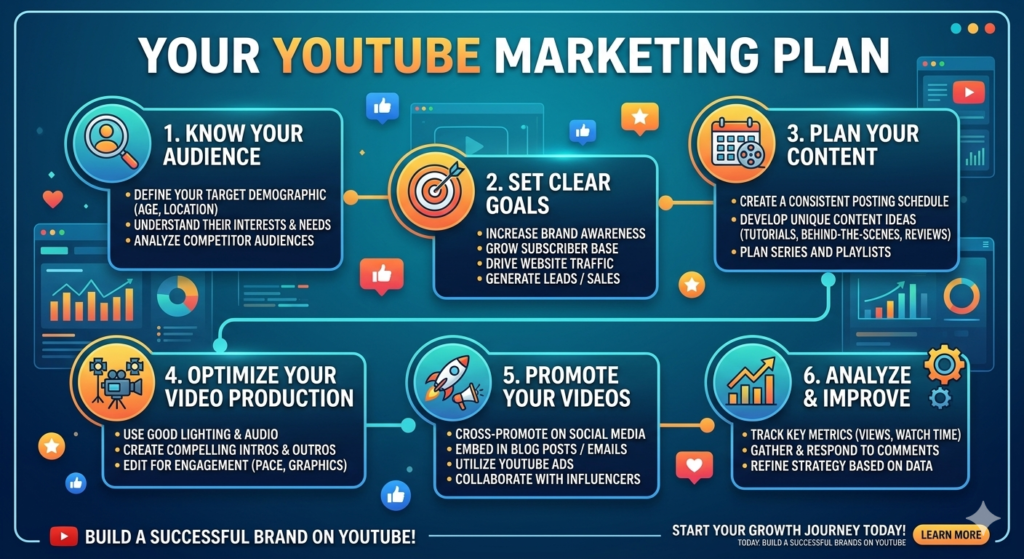
A YouTube marketing plan turns strategy into a repeatable operational system. Here is the complete six-step framework.
Audience Definition
Write a clear, specific description of your ideal viewer:
- Age range and demographic profile
- Primary pain points and goals
- What they search for on YouTube specifically
- What outcome they want from your content
- What other channels they watch and why
Channel Positioning Statement
Define your channel’s unique angle in one sentence:
“[Channel name] helps [specific audience] achieve [specific outcome] through [content format/unique approach] unlike other channels which [weakness of competitors].”
This positioning statement should guide every content decision you make for the life of the channel.
Keyword Research and 90-Day Content Calendar
- Identify 50–100 keyword targets organized into 5–10 topic clusters
- Assign keywords to specific video ideas
- Build a rolling 90-day content calendar with publish dates
- Flag which videos will be supported by Shorts and Community Posts
- Identify which videos are evergreen versus trending
Production Workflow Design
Define your complete script-to-publish workflow:
- Research: How each video topic gets researched and validated
- Scripting: Who writes scripts and what template they follow
- Production: How videos are recorded or generated (AI tools, screen recording, talking head, faceless)
- Editing: Who edits, what software is used, what the quality standard is
- Optimization: Who writes titles, descriptions, tags, and creates thumbnails
- Upload and scheduling: Who publishes, when, and how uploads are optimized
Systematizing this workflow is what makes consistent YouTube channel marketing achievable at scale whether you are a solo creator or a team of five.
Analytics Review Cadence
Review your YouTube analytics every two weeks and track:
- Click-through rate by video identify thumbnail and title patterns that work
- Average view duration identify where viewers drop off and fix it
- Subscriber conversion rate identify which videos convert viewers to subscribers most effectively
- Traffic sources understand whether growth comes from search, Browse, Suggested, or external
Double down on formats and topics that consistently outperform. Cut or revise approaches that consistently underperform. Let data drive your YouTube marketing strategy rather than gut feeling.
Monetization Integration
Define exactly how your YouTube marketing plan connects to revenue:
| Revenue Stream | How YouTube Feeds It |
|---|---|
| AdSense | Views and watch time |
| Sponsorships | Audience size and engagement |
| Affiliate commissions | Description links and CTAs |
| Course or product sales | End screens and pinned comments |
| Coaching or consulting | Channel authority and trust |
| Agency client acquisition | Channel as a portfolio |
Every CTA in every video should serve one of these revenue pathways explicitly.
YouTube Marketing Tips: The Non-Negotiables
After everything covered above, these are the YouTube marketing tips that apply universally the fundamentals that separate channels that grow from channels that stay stuck.
Content and SEO:
- Always research keywords before creating any content never create blind
- Optimize title, description, and thumbnail before every single upload
- Write video descriptions of at least 200 words with natural keyword integration
- Add chapters to every video over 5 minutes in length
Growth and Consistency:
- Publish on a consistent schedule and treat it like a non-negotiable commitment
- Hook viewers in the first 30 seconds if you lose them there, nothing else matters
- Build playlists around topic clusters rather than random groupings
- Use Shorts for discovery and long-form for depth and trust-building
Audience and Community:
- Respond to every comment in the first 48 hours of a video’s publication
- Use Community Posts to stay present in subscriber feeds between uploads
- Ask one direct question at the end of every video to drive comment engagement
- Feature viewer comments and questions in follow-up content
Strategy and Business:
- Integrate YouTube into your email and social media ecosystem never keep it siloed
- Study your analytics every two weeks and iterate based on evidence
- Give every new strategy a minimum of 90 days before evaluating its effectiveness
- Always connect your content to a clear business outcome views without revenue direction are vanity
Mindset:
- Consistency beats perfection every single time
- Your first 50 videos are practice the goal is learning, not going viral
- Every video that underperforms teaches you something the successful ones cannot
- The channels you admire today were unwatchable in their first year
The Best Time to Start Is Now
The opportunity in video marketing with YouTube has never been greater. The tools available to execute a world-class YouTube marketing strategy have never been more accessible. AI content tools, improved analytics, Shorts discovery, and the platform’s continued dominance in Google search have created a window that rewards creators and businesses who move decisively.
Here is the honest truth about marketing strategies for YouTube: they are not complicated. They require patience, consistency, and a willingness to iterate based on evidence rather than feeling. The channels that master these fundamentals are the ones that compound their growth month after month while their competitors wonder why nothing is working.
Your YouTube marketing plan does not need to be perfect on day one. It needs to be:
- Consistent: Published regularly on a sustainable schedule
- Keyword-informed: Built around what your audience is actually searching for
- Audience-focused: Designed to serve your viewer, not perform for the algorithm
- Connected to revenue: Tied to a clear business outcome through every CTA
The brands and creators you will be competing with in three years are building their channels right now. The authority they establish today compounds into a competitive moat that becomes harder to overcome with every month that passes.
Marketing on YouTube is not a short-term tactic. It is a long-term investment in an asset that appreciates over time, generates compounding returns, and builds an audience that no algorithm change, ad platform policy update, or social media trend can take away from you.
The channels being built today are the authority brands of tomorrow.